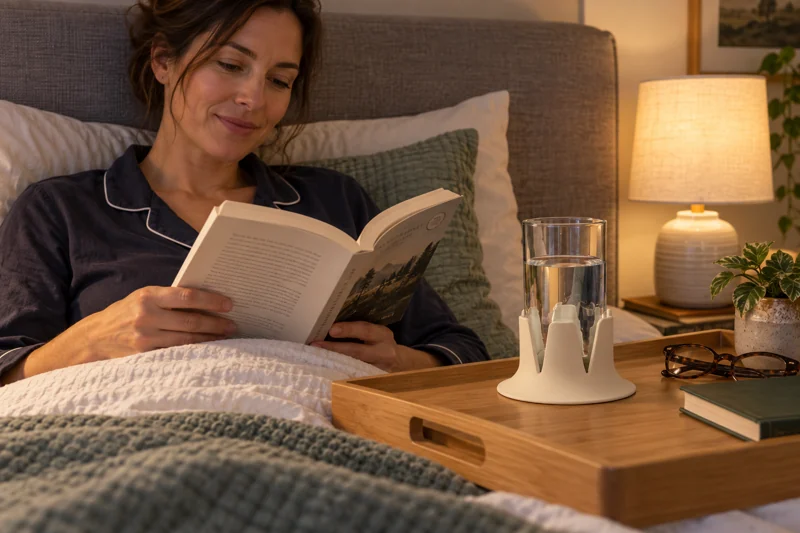
—3:07 AM, and the water is on the floor
Every clip-on bedside shelf holds by gripping something rigid. BedShelfie’s own fit guidance for its FlexFit model asks for a bed rail “1.8 inches tall or more”. Its DormEssential, with a “2.0″ clamp”, asks for 1.4 inches — or 8.1 inches of open space between the slats.
Tell that site you sleep on a platform bed and it stops offering you a clamp at all. Your mattress has no rail, no tube and no arm anywhere near your hand, so this is a 5.2″ moulded base that stands on the covers instead. No clamp, no strap, no suction, nothing tucked under the mattress.
4.9 average · 121 reviews
Choose your coloursfrom $14.95 · free shipping on every order
Ships from Orange, California. 90 days to change your mind, used is fine.
—Read this before anything else
A nightstand with no square inch left on it is a tidiness problem, and tidiness has an answer. This is a different thing. On the bed itself there is nothing rigid to hold on to, so nearly everything built for the job goes hunting somewhere else in the room — a rail, a tube, an arm, a gap between slats. Here is the menu, in the manufacturers’ own words.
$39.99
needs a bed rail
A 13.75 by 9.5 inch shelf rated to 35 lb. The fit guidance names the beds it wants — “Ikea beds, bunk beds, metal frames & dorm beds” — and the requirement: a rail “1.8 inches tall or more.”
$32.99
needs a rail, or a slat gap
A “2.0″ clamp” that asks for a rail at least 1.4 inches tall, or 8.1 inches of open space between the slats. Cheaper, same dependency.
$21.63
needs a 7/8–1″ tube
Medline’s, listed by MedMart: “Also fits bed rails with 7/8-1 inch diameter tube,” and slotted on two sides to hold a cup with handles. If there is a rail in the house, this is the correct product and it is cheap.
$14.95
needs nothing rigid
A 5.2″ moulded base, about 3.6 ounces, that the drink stands in. Set down where your hand already is, and lifted off when you are done.
Then the panel that gives the whole game away. Tell BedShelfie you have a platform bed or a box spring and it does not sell you a clamp at all — it routes you to a separate under-mattress Slide model. The homepage says it plainly: installation uses “a clamp or slide-in design, depending on your bed frame.”
Depending on your bed frame. Not on your bed. The neighbouring categories answer the same way: CouchCoaster, the weighted silicone saddle for sofa arms, states its requirement outright — “14cm / 5.5″ minimum arm width required to ensure a secure fit.” It needs an arm. A mattress inside an upholstered frame offers a padded wall and a mattress, and that is the entire inventory.
Sources: bedshelfie.com (manufacturer’s own store) · medmartonline.com (Medline product listing) · hitproducts.com (CouchCoaster). Prices and requirements fetched 4 September 2026.
—The tell that the fear is real
The thing you are afraid of at 3 AM is written into the contract. Not the sheets — the sheets go in the wash. The core. Casper’s own cleaning guidance says to spot-clean with “a little water and mild detergent,” to “never soak the foam,” and warns to “be careful not to use too much, as the foam core can soak it up.”
The cover is not an escape hatch either: “Casper mattress covers are not designed to be taken off or washed, and removing them will void your warranty.” So a knocked-over glass goes into a core you are told not to saturate, under a cover you are told not to remove, in a product the same catalogue lists between $699 and $1,765.
They all sell the fix, and the fix is not a cup holder. Casper’s waterproof mattress protector lists at $109, discounted to $76.30, fits mattresses up to 16 inches deep, and is sold on the line that it “guards your mattress against dirt, spills, and more.” Worth owning. It does not keep the drink upright and it does not spare you stripping a bed in the dark. Insurance, not a solution.
Sources: tempurpedic.com · purple.com · casper.com — published warranty, care and product pages, quoted verbatim. Fetched 4 September 2026.
—Does it actually work
A full can, and somebody sitting down beside it on an upholstered cushion. The base is 5.2 inches across and spreads the load instead of balancing the drink on its own bottom, so the whole thing has to lean a long way before it goes.
Filmed on a couch cushion — soft, compressible, and not a mattress. It is the honest footage we have and we are not going to pretend it was shot on a bed. What it shows is one nearby weight going down; what it does not show is the bed itself moving, which is a different thing and is covered in the limits below.
—Why a wide foot is the only move left
Foam firmness is reported as IFD — Indentation Force Deflection — under ASTM D3574. The Polyurethane Foam Association, the flexible-foam industry’s own trade body, defines it as the force in pounds needed to compress “a 50 square inch circular indentor foot into a four inch thick sample,” read at 25 and 65 percent of the sample’s height.
Fifty square inches. A circle of that area is 7.98 inches across — a dinner plate. Everything you believe about how firm your mattress is comes from pressing a dinner plate into it. Spread a load over that much area and the foam pushes back the way the spec sheet promises. Concentrate it into something narrower and the pressure per square inch climbs, and it goes in deeper. Not a defect: the material doing exactly what you paid for.
A tumbler is the opposite of that plate. Stanley lists the 40 oz Quencher H2.0 at 3.54 × 5.43 × 11.02 inches and 1.18 lb empty — nearly a foot tall, mass up high once it is full, standing on a fraction of a dinner plate’s area, on a surface engineered to yield under it.
The base here is fixed at 5.2 inches: roughly 21 square inches of footprint under a container whose own bottom is a fraction of that. The weight presses into the foam over a substantially larger area, and the base of support is far wider than the cup’s, so the drink’s centre of mass has to travel considerably further sideways before it clears the edge of what is holding it up. It resists tipping by widening the footprint. That is the whole claim, and on a bed it is the only one available.
On a hard, smooth surface — a deck board, a cooler lid — the tack of the TPU does a second job and resists sliding. Against bedding that is not something to count on, and this page does not count on it.
Sources: pfa.org glossary (Polyurethane Foam Association), reference method ASTM D3574 · stanley1913.com. Fetched 4 September 2026. The 7.98-inch figure is arithmetic from the 50-square-inch area, not a quoted specification.
—The object
—What seats and what does not
A standard 12 oz can is 2.6 inches across the barrel — Ball Corporation’s product standard gives a body outside diameter of 2.600 inches — and sits well inside the range. So does the water glass out of the cupboard. A Stanley 40 oz Quencher, which is the cup this question is usually about, is published at 3.1 inches across the base: snug, and it seats. The 30 oz is published at 3.15, which is the very top of the fin range and worth a sticky note before you order rather than after.
A handled mug does not seat at all: the handle lands exactly where the fins grip. Stemmed glasses do not seat either. Both are a straight no — and if your bedtime drink is tea in a mug, the honest answer on this page is a nightstand, a clip-on shelf, or the rail holder that is slotted for a handle.
Every width below comes from a published specification, not from us. Where a spec is uncertain, the answer says so.
A width across the bottom of the glass, in inches.
A standard sticky note is three inches square. Stand the cup on one at the kitchen counter tonight: if the bottom sits inside the paper, it will seat. One sticky note settles what no product page can.
Anything that overhangs, or anything borderline — hello@steadilabs.com reaches a person, and the answer will be honest either way, including a no.
Sources: Ball Corporation product standard (12 oz can body outside diameter 2.600 ± .008 in) · stanley1913.com. Every width in the search box is a published manufacturer or retailer figure carried with its own citation, not an estimate of ours. Fetched 4 September 2026.
—Where it goes
Put it on the flattest thing within reach — the mattress just past your hip, or a folded blanket laid down for it. Not on a fold and not on a heaped duvet: on a fold it sits at the angle of the fold, because it does not make bedding flat and does not pretend to.
Two facts make that spot exist, and neither of them is your fault.
One long side of a lot of beds is against a wall. The International Residential Code sets the floor for a habitable room — not less than 70 square feet, and “not less than 7 feet in any horizontal dimension.” Seven feet is 84 inches. The Better Sleep Council, the mattress industry’s own consumer education arm, puts a queen at 60 by 80 inches. Eighty-four minus sixty leaves twenty-four inches for both sides of the bed combined, and IKEA’s HEMNES nightstand is 13¾ inches deep, so two of them want 27½ inches before anybody walks anywhere. That is the code minimum rather than the average bedroom — but it is the arithmetic that decides studios and small rooms, where the door and the closet settle the layout before you do. Whoever sleeps on the wall side is not getting a nightstand at any price. The wall got there first.
And the nightstand you do have is not at drink height. IKEA sells a KNARREVIK at 20½ inches tall for $14.99 and a HEMNES at 27½ inches for $129.99 — seven inches apart, one store, both called the same thing. Casper lists its mattresses at 11, 12 and 14 inches on a foundation 7.5 inches high, and its own guidance says the standard bed height “sits at approximately 25 inches.” Fourteen inches of mattress on that foundation puts the sleeping surface at 21½ before a frame is involved. Neither nightstand is wrong. The two industries simply never agreed on a number, which is why reaching for a glass in the dark means reaching down and out at once, over the edge of something that gives as you lean on it.
Twelve colours, and the ones this page was built around are the quiet end of them — Quiet Morning, Fresh Linen, Oatmeal, Lamplight, Midnight. A second one on the other side of the bed is the usual order.
Sources: up.codes (IRC R304.1 and R304.2) · bettersleep.org · ikea.com · casper.com. Fetched 4 September 2026.
—Get one
Two is the usual answer — your side and the other side, or one for the bed and one for wherever you actually sit in the evening. Free shipping on all of them.
Checkout is handled by Steadi Labs — the company that makes The Bed Cup Holder. Secure checkout at steadilabs.com. Free shipping on every order, and 90 days to change your mind, used is fine.
—From people who bought one
Verbatim, unedited, not filtered by rating. This is a slice of one product-wide corpus — reviews of the Steadi, not of this page — and most of it is about couches. These four are about beds. The third one asks for the one thing we do not make.

★★★★★
I am so happy. I leave it on my cup 24/7!
Customer · 2026-08-18Photo from the buyerPhoto from the buyerPhoto from the buyerPhoto from the buyerPhoto from the buyerPhoto from the buyerPhoto from the buyer
★★★★★
As advertised and works great. If you don’t have a side table at the right spot for your couch or bed, this will solve your problem.
David White · May 2026
★★★★★
Very pleased with this. Feels premium and sturdy, and nice to look at when in use. As someone who once spilled a can of cola on the bed, I now confidently place my soda can on the bed without worry!
Michael Mendoza · May 2026
★★★★★
Literally love these. Living with chronic illness sucks and often means dinner in bed, and limiting my beverage to my side table when I have the whole mattress to picnic? I was wishing something like this existed and the algorithm delivered. Simple, lightweight, flexible! Immediately rec’d to all my friends, regardless of ability. Two thoughts- a version for mugs? Also, bright color options so I can have a hilighter orange to match my aesthetic.
Mx · July 2026
★★★★★
My kid doesn’t spill his drink in his bed anymore so….. it’s a win!
Jason Rumsey · July 2026
Sent in with their reviews. Tap any one to read it. Different rooms, different drinks, different colours — none of them staged by us.
All four are five stars, which is worth saying out loud rather than letting you assume we chose them that way. The corpus has three- and four-star reviews in it — too small, expected wider containers, slides a little — and not one of them mentions a bed, so there was no lower-rated bed review to leave out. The third review here is left in full, request and all, because it is the same answer the fit list gives: a handled mug does not seat, we have not solved it, and a page that quietly cropped that sentence would be a page you should not trust about anything else on it.
—Read this before you buy, including the part that costs us the sale
—Ninety nights
That is roughly ninety bedtimes, which is long enough to find out whether it earns its square inch of the covers or ends up in the drawer with everything else that promised the same thing. If it ends up in the drawer, send it back. Used is fine — we would rather have it back than have you keep something you resent.
—Who makes it
Scott Rodriguez made the first one after a full drink went over on a soft cushion with three kids under three in the house. It was built for spills, on the kind of surface that gives.
It was not designed for a bedroom in particular. It exists because a wide foot does the same job on a duvet that it does on a couch cushion, and because everything it cannot do on soft bedding is written out above rather than left for you to discover at 3 AM.
We make one thing and we make all of it here — the moulds, the material, the colour runs, everything within about three and a half miles of the shop.
— Scott, Steadi Labs
—Asked and answered
Neither. Nothing tucks under, nothing clamps, nothing sticks. It sits on top of the covers and lifts straight off, which is also why it works on the wall side of the bed where there is no frame edge to reach.
Yes — published at 3.1 inches across the base, which is snug and inside the fin range. The 30 oz Quencher is published at 3.15, right at the very top; run the sticky-note test on the one you own before you order.
An honest no. The handle lands exactly where the fins grip, and a stemmed glass has nothing for them to hold either. That is the limit of the design and we have not solved it.
No. It is not attached to anything, so when the bed moves everything on it moves. It widens the footprint under a drink on a still bed; it cannot steady a mattress and it is not spill-proof.
It is one solid moulded piece with no cavity to hold water, and it is dishwasher safe, top rack. Rinse it or run it through with the glasses.
Judge that from the photographs rather than from us — they are all real, none of them are renders, and the muted colours were chosen for exactly this worry. Twelve to pick from, and 90 days to change your mind if you disagree.
—Still deciding
That is the arithmetic, and it is not a hard sum. The warranty that came with the mattress excludes beverage spills by name; the protector that covers them is $109 at list. This is fifteen dollars and it goes back if you do not want it.
If you have a nightstand within reach on your side, keep your money. If your bed has a rail, buy the clip-on shelf — it is the better answer and it is not ours. If you sleep on a platform bed with one side against a wall and you have been putting the glass on the floor, that is the bed this was built for.
It was designed to be the softest thing you own, it succeeded completely, and that success is the entire problem. What it can have is a wider, deliberately low thing between the cup and the covers — a smaller promise than the ads make, and the only one this surface allows.
Choose your coloursfrom $14.95 — free shipping on every order
90-day guarantee, used is fine · Made in Orange, California